Calorie Deficit Calculator: How Much to Eat to Lose Weight
 Nikhil DingraPersonal Trainer20 November 20265 min read
Losing weight means eating a little less than your body burns, for weeks. The real question is how much less. Too small a deficit and the scale does not move, too big and you lose muscle, sleep worse and give up within three weeks.
01
Step 1: What is your BMR?
Your basal metabolic rate (BMR) is what your body burns at complete rest: breathing, heart, brain, body heat. For most people it is the biggest part of daily energy use.
Without more information, the Mifflin St Jeor equation is the best estimate. For a 30 year old man at 80 kg (176 lb) and 178 cm (5 ft 10 in) it gives about 1,770 kcal. If you roughly know your body fat percentage, the Katch McArdle formula is more precise because it starts from lean body mass. From about age 35 my app blends both formulas, because metabolism also drops per kilo of muscle as you get older.
02
Step 2: How do you calculate your TDEE?
Your total daily energy expenditure (TDEE) is your BMR plus everything you move. The most reliable way is to split it into three parts:
- Your job: sitting about 1.2 times your BMR, standing 1.3 times, physical work 1.45 times.
- Your steps: roughly 0.5 kcal per 1,000 steps and kilo of body weight. At 80 kg, 10,000 instead of 4,000 steps add about 240 kcal a day.
- Your training: an hour of strength training costs about 150 to 250 kcal extra depending on your size, not the 500 that many watches show.
03
Step 3: How big should your calorie deficit be?
A deficit of about 20 percent below your TDEE is the best compromise for most people. With a TDEE of 2,400 kcal that means about 1,900 kcal a day, roughly 500 kcal less. That is close to half a kilo (about 1 lb) of fat per week.
My app never sets more than 25 percent, however fast someone wants to lose weight, and never less than 1,300 kcal a day. Below that, muscle loss rises clearly, training becomes a struggle and hunger wins sooner or later.
04
Why is the calculated number not exact?
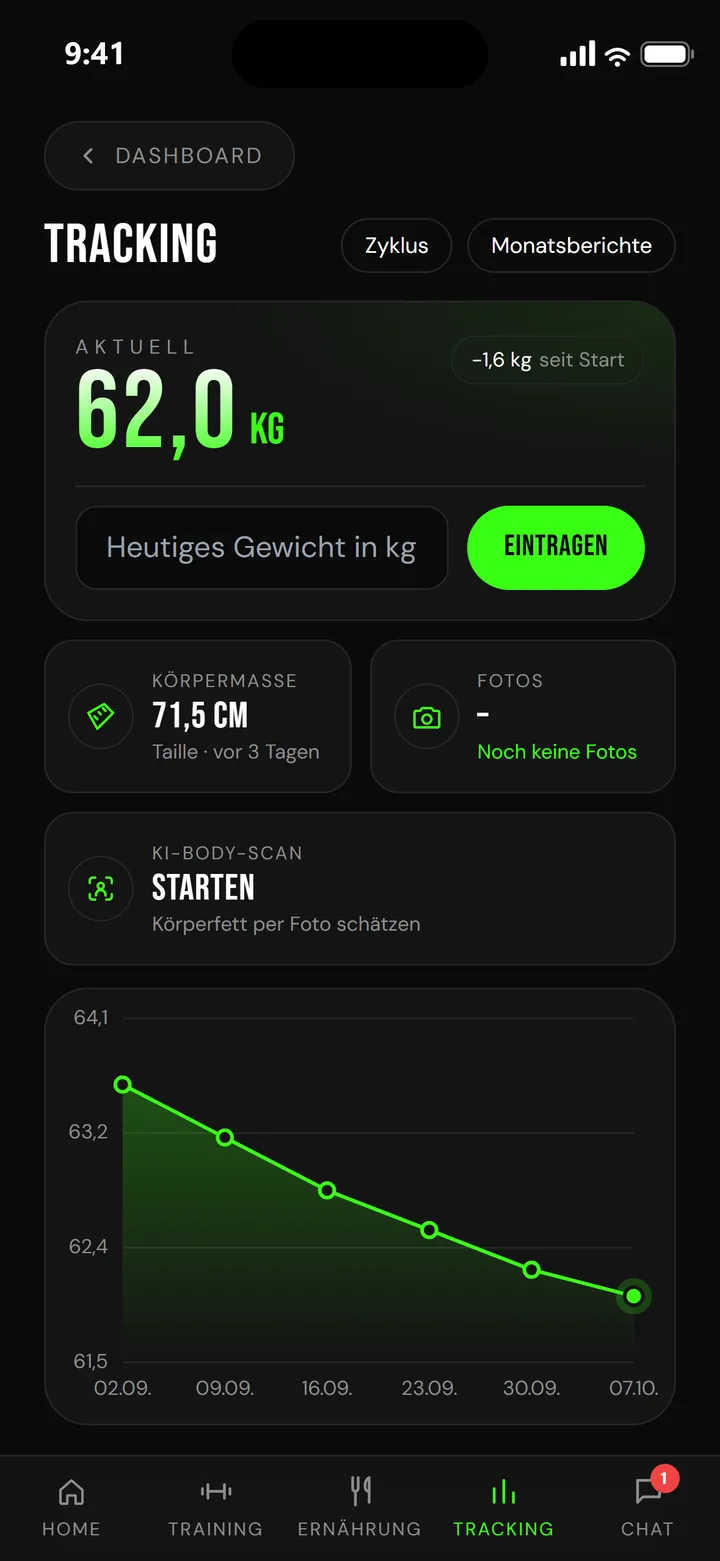
Every formula is an estimate. Two people with the same age, weight and job can be 10 percent apart. Treat the number as a starting point and watch your weight for two to three weeks, ideally every morning, and look at the weekly average.
If the weekly average drops by about 0.5 to 1 percent of your body weight per week, the deficit is right. If nothing moves although you tracked carefully, your real TDEE is lower than calculated: go down 150 to 200 kcal and watch for another two weeks.
05
Why does protein matter in a deficit?
In a deficit your body also takes energy from muscle if it has no reason to keep it. Strength training gives it that reason, enough protein gives it the material. About 2 g per kilo of body weight is a good target in a deficit, more on that in the guide on protein per day.